Department of Trade and Industry, through the Center for International Trade Expositions and Missions, is now accepting entries for the e-Services 2009 Awards, an award that acknowledges the competencies of Philippine-based companies and the talents of Filipino professionals who excel in the field of Information Technology.
The e-Services will be held in conjunction with the 9th e-Services Global Sourcing Conference and Exhibition on 9 to 10 February 2009 at the SMX Convention Center in Pasay City.
“The 9th e-Services Global Sourcing Conference and Exhibition will not only provide IT companies and experts a place to interact with other industry players as well as gain valuable insights with the interface,” said Officer-In-Charge for CITEM Ms. Ma. Lourdes D. Mediran, “it would also be a perfect avenue to recognize Filipino ingenuity and excellence and their contributions to the IT industry.”
The competition awards, which will have four categories including Outstanding Client Application of the Year, Outstanding Consumer Application of the Year, Groundbreaking Technology of the Year and Most Progressive Homegrown Company of the Year, will bring to the forefront exceptional technology products and services, outsourcing projects and homegrown business process outsourcing companies.
Winners of the 2008 e-Services Awards for the competition awards are:
- Client Application of the Year: Sun Life VUL e-Learning Program by Media Farm and ATM System Development for a major bank in Japan by Advance World Systems
- Consumer Application of the Year: Tekkids Courseware by Tech Factors Incorporated and Ur HR Partner by Navigator Systems, Inc.
- Technology of the Year: Online On-The-Job Simulation by Total Transcription Solutions, Inc., NEXT I.X. INF by Next IX, Inc. and Electronic Medical Record by EMR Global Corporation
- Progressive Homegrown Company: Pointwest Technologies, TransProcure Corporation and People Support Philippines
For the Special Citations, special recognition will be awarded to individuals, companies or institutions that have contributed to the advancement of the IT-enabled services industry in the Philippines.
This year’s e-Champion awardees in different IT fields include:
- Ernest Cu, deputy chief executive officer of Globe and former vice chairman of SPI Technologies for Country Promotion. Mr. Cu is a staunch promoter of Philippine capabilities in providing BPO service since 2000 and a member of the Public-Private Task Force for the Philippine Competitiveness on ICT.
- Janette Toral, IT consultant for Policy and Legal. Ms. Toral pushed policy efforts as an independent lobbyist and as executive director of the Congressional Oversight Committee for e-Commerce.
- Benedict Fernandez, senior vice president of e-Telecare Global Solutions for Business Development. Mr. Hernandez is a key promoter of the Philippines to the world for contact center and opened e-Telecare’s facilities to foreign companies aimed to attract investors in the country.
- Fermin Taruc, managing director of Gurango Software for Software Development. Mr. Taruc is an aggressive promoter of the Philippine software industry in the local and international market. He strongly advocates skills development, export promotion, intellectual property protection, technopreneurship and growth of domestic demand in the software industry.
e-Champions in the ESP 2007 awards include personalities namely, Sen. Mar Roxas, Sen. Ramon Magsaysay, Jr. Bong Borja of PeopleSupport and Bill Torres of Mozcom.
Echoing the sentiments of the other e-champions, Janette Toral said, “The award is an affirmation of the work done where the clear high impact outputs were used as a basis for the recognition.”
The e-Services 2008 Awardees.The awarding ceremonies would be held during the culmination of the conference and exhibition on February 10, 2009. Past judges include key people in the ICT industry such as David Barret, chairman, European Advisory Board, and Founding Member of International Association of Outsourcing Professionals; Benedict Ferrer, research manager, XMG, Inc.; Josephine Romero, trade officer, PTIC New York; Nora Terrado, country manager, Headstrong; and Gerry Valenciano, director, ICCP Venture Partners, Inc.
Since its inception in 2001, the e-Services Global Sourcing Conference and Exhibition has been a major driving force for the industry. The list of participating exhibitors and professionals has steadily increased through the years.
The event was an important platform for IT ideas and thought-sharing between specialists and key decision makers both locally and internationally. The exhibit held in 2007 attracted more than 200 exhibitors while the business conference brought in 1,300 participants from here and other countries like Japan, Korea, Australia, the United States, the Netherlands, the United Kingdom, India, Singapore, Malaysia and Indonesia.
Interested parties for the ESP Awards 2009 must submit their nominations on or before December 29, 2008.
Wednesday, December 10, 2008


Monday, December 08, 2008
Help Find My Missing Husband
Hi OFWJC,
My cousin Anita Nino (pronounced Ninyo) De La Torre handed me your magazine "OFW Journalism Consortium", asking for help in locating his husband, which the husband abandoned her since 1999. She's doing this in favor of her husband's family, especially to her mother-in-law, Teresita Ebol De La Torre who is currenty sick.
Details of his husband;
Name: SYLVAN EBOL DE LA TORRE
Born on June 12, 1954 in Zamboanga City
The first time he left the country(Philipines) was on 1989 for Saipan, Commonwealth of the Northern Mariana Islands (Near Guam), as a Security Guard. He came back in Iloilo City last 1996 for awhile and go back Saipan same year and left Saipan on November 1999.
Since 1999 up to now no word or any communications of some sort was heard from him.
My cousin Anita accepted the fact the his husband abandoned him but the husband's family is asking his(Sylvan) whereabouts from her. Sylvan's father Segio De La Torre died last May 2006. Sylan's mother is too ill and I think her dying wish to see her son (Sylvan) before she leaves this cruel world.
Since your magazine is being read globally, we are hoping, really hoping that it would shed light to Sylvan's "abandonement or disappearance" .
Please contact the wife any news regarding Sylvan's whereabouts;
Anita Nino De La Torre
Cell: (0918) 706-3948
or mail to her address;
Zone 3, Calumpang, Molo, Iloilo City, Phils., 5000
Thank you very much and more power to your magazine.
I salute you and all the people behind this noble task of servicing to all OFW's globally!!!! !
Merry Christmas!!! !!
Sincerely,
Jerry of Iloilo City
My cousin Anita Nino (pronounced Ninyo) De La Torre handed me your magazine "OFW Journalism Consortium", asking for help in locating his husband, which the husband abandoned her since 1999. She's doing this in favor of her husband's family, especially to her mother-in-law, Teresita Ebol De La Torre who is currenty sick.
Details of his husband;
Name: SYLVAN EBOL DE LA TORRE
Born on June 12, 1954 in Zamboanga City
The first time he left the country(Philipines) was on 1989 for Saipan, Commonwealth of the Northern Mariana Islands (Near Guam), as a Security Guard. He came back in Iloilo City last 1996 for awhile and go back Saipan same year and left Saipan on November 1999.
Since 1999 up to now no word or any communications of some sort was heard from him.
My cousin Anita accepted the fact the his husband abandoned him but the husband's family is asking his(Sylvan) whereabouts from her. Sylvan's father Segio De La Torre died last May 2006. Sylan's mother is too ill and I think her dying wish to see her son (Sylvan) before she leaves this cruel world.
Since your magazine is being read globally, we are hoping, really hoping that it would shed light to Sylvan's "abandonement or disappearance" .
Please contact the wife any news regarding Sylvan's whereabouts;
Anita Nino De La Torre
Cell: (0918) 706-3948
or mail to her address;
Zone 3, Calumpang, Molo, Iloilo City, Phils., 5000
Thank you very much and more power to your magazine.
I salute you and all the people behind this noble task of servicing to all OFW's globally!!!! !
Merry Christmas!!! !!
Sincerely,
Jerry of Iloilo City
Industry Leader Urges Govt Coordinate Contingency Plan for OFWs
Loreto B. Soriano, executive director of the Federated Association of Manpower Exporters, Inc. urged the government, particularly the Department of Labor and Employment, to coordinate with the private sector the activities under its contingency plan for overseas Filipino workers prematurely terminated and repatriated on account of the global financial crisis.
“We at the Federation call on the DOLE to convene a meeting with its social partners in the overseas employment sector to harmonize its contingency plan for OFWs temporarily sidelined by the financial crisis,” Soriano said, noting that affected OFWs are starting to arrive home in trickles.
“In October, when we warned of the crisis’ impact on OFWs, we did not anticipate that OFWS would be sent home this early. We said it would be about March 2009 when we will start feeling the pinch. Because of this development, it is important that the DOLE initiate dialogues on how best we in the private sector could help,” he said.
Soriano said that the Federation has already asked its member-associations to establish a database of prematurely-retrenched OFWs that could be made available in a pool from where overseas employment service providers can recruit qualified workers for jobs in their respective countries of deployment.
Noting reports of OFWs who have come home because of the crisis, Soriano said OESPs are bracing for more ‘balik-bayan’ OFWs this Christmas and in the first three months of 2009.
He expressed optimism that the Philippines can ride out the global financial storm. However, he pointed out that only those OFWs who have professional and technical skills and expertise may escape the deluge of retrenchment that is expected but those who have no skills mostly in the services sector might lose their jobs.
He singled out the Middle East, notably Saudi Arabia, which continues to exhibit strong demand for OFWs.
Soriano, though, also observed that many OFWs are now selective and hesitate to work in Saudi Arabia, preferring the West, such as Canada, the US, and Australia, where salaries are much higher. Because of this, he suggested that one activity that the DOLE can do is to conduct counseling for prospective OFWs on the benefits of working in the Middle East.
“We have to change OFW attitudes about workplaces and biases against the Middle East and disregard our preferences in a time of crisis. Let’s encourage our OFWs to go to countries that have work and decent pay, rather than to countries that pay higher salaries but the jobs are not available,” he said.
“We at the Federation call on the DOLE to convene a meeting with its social partners in the overseas employment sector to harmonize its contingency plan for OFWs temporarily sidelined by the financial crisis,” Soriano said, noting that affected OFWs are starting to arrive home in trickles.
“In October, when we warned of the crisis’ impact on OFWs, we did not anticipate that OFWS would be sent home this early. We said it would be about March 2009 when we will start feeling the pinch. Because of this development, it is important that the DOLE initiate dialogues on how best we in the private sector could help,” he said.
Soriano said that the Federation has already asked its member-associations to establish a database of prematurely-retrenched OFWs that could be made available in a pool from where overseas employment service providers can recruit qualified workers for jobs in their respective countries of deployment.
Noting reports of OFWs who have come home because of the crisis, Soriano said OESPs are bracing for more ‘balik-bayan’ OFWs this Christmas and in the first three months of 2009.
He expressed optimism that the Philippines can ride out the global financial storm. However, he pointed out that only those OFWs who have professional and technical skills and expertise may escape the deluge of retrenchment that is expected but those who have no skills mostly in the services sector might lose their jobs.
He singled out the Middle East, notably Saudi Arabia, which continues to exhibit strong demand for OFWs.
Soriano, though, also observed that many OFWs are now selective and hesitate to work in Saudi Arabia, preferring the West, such as Canada, the US, and Australia, where salaries are much higher. Because of this, he suggested that one activity that the DOLE can do is to conduct counseling for prospective OFWs on the benefits of working in the Middle East.
“We have to change OFW attitudes about workplaces and biases against the Middle East and disregard our preferences in a time of crisis. Let’s encourage our OFWs to go to countries that have work and decent pay, rather than to countries that pay higher salaries but the jobs are not available,” he said.
Puregold Price Club Further Invests in JDA Software to Support Long-Term Growth Initiatives
Local Retailer Expects to Increase Competitive Advantage with JDA’s Merchandise Operations and Space & Category Management Solutions
MANILA--JDA Software Group, Inc. announced that Puregold Price Club Inc., a leading general merchandise retailer in the Philippines , has extended its investment in JDA Software’s Merchandise Operations and Space & Category Management suites with the selection of JDA Space Planning and JDA Floor Planning and the acquisition of additional software licenses for JDA’s Merchandise Management System.
Puregold has used MMS for five years and continues to invest in the solution to support its long-term strategic growth plans. MMS integrates and distributes data throughout Puregold’s organization, supporting its core-inventory control, cost and price management, purchase order management, and automated replenishment and allocation of products.
“We have the ability to make more informed and timely decisions, respond rapidly to changes in the competitive environment and monitor store-level activity with the support of JDA’s Merchandise Management System,” explained Ruel Magat, senior IT manager for systems, Puregold. “It is a pivotal investment in helping us achieve operational efficiencies and support our strategic growth initiatives.”
JDA’s Space Planning and Floor Planning solutions will enable the retailer to further increase its competitive advantage and maximize profit margins.
“We expect to further reduce stockouts, streamline workflow and decision-making, and improve our planogram consistency and accuracy with the use of JDA’s Space & Category Management solutions,” said Bong Balcos, senior IT manager for technical & operations, Puregold.
Stephen McNulty, JDA regional vice president, Asia Pacific, said, “Retailers are implementing category management solutions as a key strategy to increase competitiveness and drive profitability in today’s tough economic climate. JDA’s innovative solutions enable retailers like Puregold to fulfill the ultimate goal of assortment optimization by tailoring specific assortments to consumers’ needs through improved clustering techniques and store-specific category management decision support tools, achieving true precision merchandising.”
###
About JDA Software Group, Inc.
JDA® Software Group, Inc. is focused on helping companies realize real supply chain and revenue management results – fast. JDA Software delivers integrated merchandising as well as supply chain and revenue management planning, execution, and optimization solutions for the consumer-driven supply chain and services industries. Through its industry-leading solutions, leading manufacturers, distributors, retailers, and services companies around the world are growing their businesses with greater predictability and more profitably.
MANILA--JDA Software Group, Inc. announced that Puregold Price Club Inc., a leading general merchandise retailer in the Philippines , has extended its investment in JDA Software’s Merchandise Operations and Space & Category Management suites with the selection of JDA Space Planning and JDA Floor Planning and the acquisition of additional software licenses for JDA’s Merchandise Management System.
Puregold has used MMS for five years and continues to invest in the solution to support its long-term strategic growth plans. MMS integrates and distributes data throughout Puregold’s organization, supporting its core-inventory control, cost and price management, purchase order management, and automated replenishment and allocation of products.
“We have the ability to make more informed and timely decisions, respond rapidly to changes in the competitive environment and monitor store-level activity with the support of JDA’s Merchandise Management System,” explained Ruel Magat, senior IT manager for systems, Puregold. “It is a pivotal investment in helping us achieve operational efficiencies and support our strategic growth initiatives.”
JDA’s Space Planning and Floor Planning solutions will enable the retailer to further increase its competitive advantage and maximize profit margins.
“We expect to further reduce stockouts, streamline workflow and decision-making, and improve our planogram consistency and accuracy with the use of JDA’s Space & Category Management solutions,” said Bong Balcos, senior IT manager for technical & operations, Puregold.
Stephen McNulty, JDA regional vice president, Asia Pacific, said, “Retailers are implementing category management solutions as a key strategy to increase competitiveness and drive profitability in today’s tough economic climate. JDA’s innovative solutions enable retailers like Puregold to fulfill the ultimate goal of assortment optimization by tailoring specific assortments to consumers’ needs through improved clustering techniques and store-specific category management decision support tools, achieving true precision merchandising.”
###
About JDA Software Group, Inc.
JDA® Software Group, Inc. is focused on helping companies realize real supply chain and revenue management results – fast. JDA Software delivers integrated merchandising as well as supply chain and revenue management planning, execution, and optimization solutions for the consumer-driven supply chain and services industries. Through its industry-leading solutions, leading manufacturers, distributors, retailers, and services companies around the world are growing their businesses with greater predictability and more profitably.
Enrile to Block Term-extension Moves, 2010 Polls Postponement
Senate President Juan Ponce Enrile has said he will not support any move to extend the stay in office of President Arroyo and other elective officials beyond their mandated terms of office, nor will he back plans to "dispense with or postpone" the 2010 elections.
In a statement, Enrile reiterated that he would lead senators in questioning before the Supreme Court moves emanating from the House of Representatives seeking to amend the 1987 Constitution through a Constituent Assembly with the two chambers voting jointly rather than separately.
"I am vehemently against any move to extend the terms of elective government officials, including the President and I will not support any move to dispense with or postpone the elections in 2010," Enrile said.
"If need be, I will lead the senate in opposing and challenging the legality of moves emanating from the House of Representatives to oppose changes in the Charter through a Constituent Assembly that will render the Senate inutile by the insistence of House members that they can undertake this effort via joint voting rather than the two Houses voting separately," he added.
Enrile revealed he was willing to appear and argue his case before the Supreme Court.
Nonetheless, he said he was in favor of amending certain provisions of the 1987 Constitution, especially plans to shift to a unicameral legislature as well as plans to review the economic provisions in order to help the country cope with the need to encourage investments and enable it to compete in the international market.
As Senate President, Enrile pointed out, he must ensure that the Chamber "remains united against dubious designs and schemes to amend the Constitution to serve the interests of the incumbents and other vested political interests."
"I have sworn to protect and fight for the Senate as an institution and if need be, at the proper time, I am willing to argue the case myself before the Supreme Court," Enrile said.
In Malacañang, Deputy Presidential Spokesperson Lorelei Fajardo reiterated the palace's opposition against extending the term of President Arroyo, amid the growing resistance against Charter change which is widely perceived as a move to prolong her tenure.
Fajardo said the President is pushing for Charter change to introduce economic and political reforms but term extension is not part of her agenda. She said she doubts Charter change will prosper because the public normally associates it with term extensions.
Fajardo reiterated that the President herself is willing to step down from office on June 30, 2010.
Last week, Enrile vowed that he would preside over a Senate that will maintain its reputation of independence and uphold its tradition of integrity and freedom by making it free from personal political interests.
Enrile told Senate employees he will be guided only by public interests in the performance of his tasks as Senate President.
"I can assure you that I will never do anything that will shame the Senate," Enrile said. "I will maintain its reputation of independence, its tradition of integrity and freedom, unencumbered by any political consideration, unencumbered by any political ambition and unencumbered by any of my own personal interest."
In a statement, Enrile reiterated that he would lead senators in questioning before the Supreme Court moves emanating from the House of Representatives seeking to amend the 1987 Constitution through a Constituent Assembly with the two chambers voting jointly rather than separately.
"I am vehemently against any move to extend the terms of elective government officials, including the President and I will not support any move to dispense with or postpone the elections in 2010," Enrile said.
"If need be, I will lead the senate in opposing and challenging the legality of moves emanating from the House of Representatives to oppose changes in the Charter through a Constituent Assembly that will render the Senate inutile by the insistence of House members that they can undertake this effort via joint voting rather than the two Houses voting separately," he added.
Enrile revealed he was willing to appear and argue his case before the Supreme Court.
Nonetheless, he said he was in favor of amending certain provisions of the 1987 Constitution, especially plans to shift to a unicameral legislature as well as plans to review the economic provisions in order to help the country cope with the need to encourage investments and enable it to compete in the international market.
As Senate President, Enrile pointed out, he must ensure that the Chamber "remains united against dubious designs and schemes to amend the Constitution to serve the interests of the incumbents and other vested political interests."
"I have sworn to protect and fight for the Senate as an institution and if need be, at the proper time, I am willing to argue the case myself before the Supreme Court," Enrile said.
In Malacañang, Deputy Presidential Spokesperson Lorelei Fajardo reiterated the palace's opposition against extending the term of President Arroyo, amid the growing resistance against Charter change which is widely perceived as a move to prolong her tenure.
Fajardo said the President is pushing for Charter change to introduce economic and political reforms but term extension is not part of her agenda. She said she doubts Charter change will prosper because the public normally associates it with term extensions.
Fajardo reiterated that the President herself is willing to step down from office on June 30, 2010.
Last week, Enrile vowed that he would preside over a Senate that will maintain its reputation of independence and uphold its tradition of integrity and freedom by making it free from personal political interests.
Enrile told Senate employees he will be guided only by public interests in the performance of his tasks as Senate President.
"I can assure you that I will never do anything that will shame the Senate," Enrile said. "I will maintain its reputation of independence, its tradition of integrity and freedom, unencumbered by any political consideration, unencumbered by any political ambition and unencumbered by any of my own personal interest."
Wednesday, December 03, 2008
JICA Projects Up for Ex-post Evaluation
Two Japanese International Cooperation Agency (JICA)-assisted projects are up for ex-post evaluation this year—the Fisheries Resort Management Project (FRMP) of the Bureau of Fisheries and Aquatic Resources (BFAR)-Department of Agriculture (DA) and the Metro Manila Strategic Mass Rail Development Project (LRT2) of the Light Rail Transit Authority (LRTA).
The National Economic and Development Authority (NEDA) and JICA will conduct the joint ex-post evaluation as discussed in a recent meeting at the Richmonde Hotel, Pasig City. NEDA Project Monitoring Staff (PMS) Director Roderick M. Planta and JICA-Tokyo representative Maki Tomika led the meeting.
According to Planta, the joint ex-post evaluation kick-off meeting aims to formally start the ex-post evaluation process for the year and draw up schedules for submission of data and preliminary results, as well as the review and validation.
Currently, information is being collected by the evaluators through field visits and surveys with the implementers and beneficiaries. All information should be collected by February next year for analysis and preparation of the preliminary report, which will be presented in May. The final evaluation of these projects will be presented in August 2009, and published in March 2010.
The projects will be subjected to the five Organization of Economic Cooperation and Development-Development Assistance Committee’s (DAC) evaluation criteria—relevance, efficiency, effectiveness, impact and sustainability. The project’s objectives, scope and needs both at the appraisal and current status will be measured. The evaluators will also compare the plans, project duration and costs with the project results and analyze the efficiency of implementation. Effectiveness will be evaluated by comparing planned and actual figures using operational and effect indicators and internal rates of return to examine the extent to which project objectives have been attained. Impact will be assessed by the direct and indirect effects of the project, both quantitatively and qualitatively. Finally, the project’s sustainability will be measured by examining its medium and long-term effects and looking at countermeasures to resolve problems, if any.
After considering all the above criteria, the project will then be given a final rating, ranging from A (highly satisfactory), B (satisfactory), C (moderately satisfactory) to D
(unsatisfactory).
The ex-post evaluation for 2008 is the last of the three-year Memorandum of Understanding (MOU) between NEDA and the Japan Bank for International Cooperation (JBIC), which was signed May 2006 before its merge with the JICA in October. The MOU includes carrying out of joint evaluation of JBIC projects; policy dialogues and feedback seminars; study groups to develop evaluation methods; and institutional improvement thru information exchange on evaluation mechanisms.
The National Economic and Development Authority (NEDA) and JICA will conduct the joint ex-post evaluation as discussed in a recent meeting at the Richmonde Hotel, Pasig City. NEDA Project Monitoring Staff (PMS) Director Roderick M. Planta and JICA-Tokyo representative Maki Tomika led the meeting.
According to Planta, the joint ex-post evaluation kick-off meeting aims to formally start the ex-post evaluation process for the year and draw up schedules for submission of data and preliminary results, as well as the review and validation.
Currently, information is being collected by the evaluators through field visits and surveys with the implementers and beneficiaries. All information should be collected by February next year for analysis and preparation of the preliminary report, which will be presented in May. The final evaluation of these projects will be presented in August 2009, and published in March 2010.
The projects will be subjected to the five Organization of Economic Cooperation and Development-Development Assistance Committee’s (DAC) evaluation criteria—relevance, efficiency, effectiveness, impact and sustainability. The project’s objectives, scope and needs both at the appraisal and current status will be measured. The evaluators will also compare the plans, project duration and costs with the project results and analyze the efficiency of implementation. Effectiveness will be evaluated by comparing planned and actual figures using operational and effect indicators and internal rates of return to examine the extent to which project objectives have been attained. Impact will be assessed by the direct and indirect effects of the project, both quantitatively and qualitatively. Finally, the project’s sustainability will be measured by examining its medium and long-term effects and looking at countermeasures to resolve problems, if any.
After considering all the above criteria, the project will then be given a final rating, ranging from A (highly satisfactory), B (satisfactory), C (moderately satisfactory) to D
(unsatisfactory).
The ex-post evaluation for 2008 is the last of the three-year Memorandum of Understanding (MOU) between NEDA and the Japan Bank for International Cooperation (JBIC), which was signed May 2006 before its merge with the JICA in October. The MOU includes carrying out of joint evaluation of JBIC projects; policy dialogues and feedback seminars; study groups to develop evaluation methods; and institutional improvement thru information exchange on evaluation mechanisms.
TG Guingona's statement on the 4th Impeachment complaint against GMA
Statement of Congressman Teofisto “TG” Guingona III, 2nd district, Province of Bukidnon, on the day of the plenary voting of the House of Representatives on the fourth Impeachment Complaint against Gloria Macapagal Arroyo. Tuesday, December 2, 2008.
Today, for the fourth time, Gloria Macapagal Arroyo and her allies refuse to answer the basic charges of lying, stealing, cheating and the slaughter of her own countrymen. In her maneuvering to escape accountability, in blocking the light of truth, in her refusal to bring about closure to the basic issue of legitimacy, the damage to the institutions of Philippine society has been almost irreparable. The Office of the President, Congress, the Armed Forces, the Ombudsman, the COMELEC, the Department of Justice, and the Civil Service are among the casualties brought about by Gloria Macapagal Arroyo’s shameless sense of impunity. Gloria Macapagal Arroyo, you have destroyed the credibility, integrity, and most deplorably, you have destroyed the faith of the Filipino people in these public institutions.
You have destroyed the people’s faith in the Armed Forces. You have manipulated the military for your cheating in the 2004 election. This was shown by the testimony of General Gudani when he was relieved of his command during the counting of the votes in Lanao del Sur to give them a free hand in manipulating the election results. AFP was then on full red alert but he was ordered to return to Manila and play golf for one week.
You have destroyed the people’s faith in the Ombudsman as an anti-corruption institution, by appointing Merceditas Gutierrez, a classmate and friend of Mike Arroyo, whose sole purpose is to protect you and your criminal allies from going to jail. This can be seen by the dismissal of the case against COMELEC Chairman Abalos for the purchase of the Megapacific computerized counting machines, even after the Supreme Court has declared the transaction illegal and even when the Ombudsman’s field investigator, Maria Elena Roxas, recommended prosecution. The Ombudsman sat on the case for two and a half years, and then dismissed it. Another example is the bribery case of Nani Perez, which has been dismissed due to the Ombudsman’s inaction. A case which was delayed for seven years. Even now, whilst Jocjoc Bolante testifies in the Senate, you have not even filed charges against him. This should have been done two years ago when the Senate Committee on Agriculture came out with its report.
You have destroyed the integrity of the Department of Justice, whose main pre-occupation is persecuting and prosecuting those who speak their mind against your administration.
You have destroyed the independence of the House of Representatives and have manipulated congressmen through the use of cash gifts, through the withholding of their CDF’s until they come to you in Malacañang to beg and kneel before you. Congress has become nothing more than an annex of Malacanang.
You have destroyed the faith of the people in the COMELEC and the election process by appointing operators like Virgilio Garcillano of the “Hello Garci Tapes”.
You have destroyed the Civil Service Commission. The former Chairman, Ms. Karina David, has already stated that nearly 60% of the 4,000 government positions, from directors to undersecretaries, are not qualified. You have appointed them on the sole basis of their blind loyalty to you.
You have neglected our agriculture, and as a consequence, we are a people unable to feed ourselves. Instead, we are becoming the world’s largest rice importer. To make matters worse, you have appointed your friends who steal whatever limited agricultural funding for your re-election, just like what Jocjoc Bolante did.
Our people have become poorer under your administration. From the years of 2003 to 2006, when you were bragging about your GDP statistics, the National Statistics Office, a government agency, reported that the poor have increased from 4 million to 4.7 million families.
You have destroyed the faith of the Filipino in the Office of the President. Your leadership and mis-governance has made the Philippines the most corrupt country in East Asia. You refuse to confront the basic issue of legitimacy. Therefore, you have no right to the Office of the President. You are a usurper that should leave immediately!!!
Now, as in 2006, you and your allies are poised to desecrate the Constitution of our Republic, by amending the Charter, thereby making you a President for life.
All these, just to escape accountability and perpetuate yourself in power.
Today, the hollow victory might be Gloria Macapagal Arroyo’s but we all know that the damage is on the faith of the Filipino people in the political and governmental institutions.
So what!? Gloria Macapagal Arroyo does not care --- as long as she remains in power, by whatever means --- even through the barrel of the gun.
What has been shattered is hope ---- hope of the Filipino to live a meaningful and peaceful life in this country. Hope for the youth of this land who are constantly searching for a brighter tomorrow.
Natatandaan ko noong 2006, iyong sinabi ng isang grupo ng overseas Filipino workers sa Lebanon habang hinihikayat sila ng ating pamahalaan na bumalik sa Pilipinas dahil binobomba at ginigiyera ng Israel ang Lebanon. Ang sagot nila: ”Thank you, but no thank you. Hindi kami babalik. Dito na lang kami sa Lebanon kahit may giyera dito. Sapagka’t walang mangyayari sa amin diyan sa Pilipinas. Wala kaming nakikitang magandang kinabukasan sa Pilipinas. ------- This is the kind of cynicism, pessimism, and hopelessness that Gloria Macapagal Arroyo’s blatant and shameless manipulations have produced.
These past few days I have been asked: “IS THERE STILL HOPE IN THIS COUNTRY?” My answer is: Yes, there is still hope in this country!!! Our voting for the Impeachment of GMA is a signal of defiance. We will continue to fight. We will never give up the struggle to make public officers accountable to the people. We will continue until we have achieved a democratic political rebirth of our nation. In this sense, the impeachment is not the end but only the beginning.
My vote tells the whole nation that there are those who will not, no matter what the odds are -- will not stop until accountability of public officers is achieved, until faith in all political institutions is restored, and genuine democracy is realized.
Today, for the fourth time, Gloria Macapagal Arroyo and her allies refuse to answer the basic charges of lying, stealing, cheating and the slaughter of her own countrymen. In her maneuvering to escape accountability, in blocking the light of truth, in her refusal to bring about closure to the basic issue of legitimacy, the damage to the institutions of Philippine society has been almost irreparable. The Office of the President, Congress, the Armed Forces, the Ombudsman, the COMELEC, the Department of Justice, and the Civil Service are among the casualties brought about by Gloria Macapagal Arroyo’s shameless sense of impunity. Gloria Macapagal Arroyo, you have destroyed the credibility, integrity, and most deplorably, you have destroyed the faith of the Filipino people in these public institutions.
You have destroyed the people’s faith in the Armed Forces. You have manipulated the military for your cheating in the 2004 election. This was shown by the testimony of General Gudani when he was relieved of his command during the counting of the votes in Lanao del Sur to give them a free hand in manipulating the election results. AFP was then on full red alert but he was ordered to return to Manila and play golf for one week.
You have destroyed the people’s faith in the Ombudsman as an anti-corruption institution, by appointing Merceditas Gutierrez, a classmate and friend of Mike Arroyo, whose sole purpose is to protect you and your criminal allies from going to jail. This can be seen by the dismissal of the case against COMELEC Chairman Abalos for the purchase of the Megapacific computerized counting machines, even after the Supreme Court has declared the transaction illegal and even when the Ombudsman’s field investigator, Maria Elena Roxas, recommended prosecution. The Ombudsman sat on the case for two and a half years, and then dismissed it. Another example is the bribery case of Nani Perez, which has been dismissed due to the Ombudsman’s inaction. A case which was delayed for seven years. Even now, whilst Jocjoc Bolante testifies in the Senate, you have not even filed charges against him. This should have been done two years ago when the Senate Committee on Agriculture came out with its report.
You have destroyed the integrity of the Department of Justice, whose main pre-occupation is persecuting and prosecuting those who speak their mind against your administration.
You have destroyed the independence of the House of Representatives and have manipulated congressmen through the use of cash gifts, through the withholding of their CDF’s until they come to you in Malacañang to beg and kneel before you. Congress has become nothing more than an annex of Malacanang.
You have destroyed the faith of the people in the COMELEC and the election process by appointing operators like Virgilio Garcillano of the “Hello Garci Tapes”.
You have destroyed the Civil Service Commission. The former Chairman, Ms. Karina David, has already stated that nearly 60% of the 4,000 government positions, from directors to undersecretaries, are not qualified. You have appointed them on the sole basis of their blind loyalty to you.
You have neglected our agriculture, and as a consequence, we are a people unable to feed ourselves. Instead, we are becoming the world’s largest rice importer. To make matters worse, you have appointed your friends who steal whatever limited agricultural funding for your re-election, just like what Jocjoc Bolante did.
Our people have become poorer under your administration. From the years of 2003 to 2006, when you were bragging about your GDP statistics, the National Statistics Office, a government agency, reported that the poor have increased from 4 million to 4.7 million families.
You have destroyed the faith of the Filipino in the Office of the President. Your leadership and mis-governance has made the Philippines the most corrupt country in East Asia. You refuse to confront the basic issue of legitimacy. Therefore, you have no right to the Office of the President. You are a usurper that should leave immediately!!!
Now, as in 2006, you and your allies are poised to desecrate the Constitution of our Republic, by amending the Charter, thereby making you a President for life.
All these, just to escape accountability and perpetuate yourself in power.
Today, the hollow victory might be Gloria Macapagal Arroyo’s but we all know that the damage is on the faith of the Filipino people in the political and governmental institutions.
So what!? Gloria Macapagal Arroyo does not care --- as long as she remains in power, by whatever means --- even through the barrel of the gun.
What has been shattered is hope ---- hope of the Filipino to live a meaningful and peaceful life in this country. Hope for the youth of this land who are constantly searching for a brighter tomorrow.
Natatandaan ko noong 2006, iyong sinabi ng isang grupo ng overseas Filipino workers sa Lebanon habang hinihikayat sila ng ating pamahalaan na bumalik sa Pilipinas dahil binobomba at ginigiyera ng Israel ang Lebanon. Ang sagot nila: ”Thank you, but no thank you. Hindi kami babalik. Dito na lang kami sa Lebanon kahit may giyera dito. Sapagka’t walang mangyayari sa amin diyan sa Pilipinas. Wala kaming nakikitang magandang kinabukasan sa Pilipinas. ------- This is the kind of cynicism, pessimism, and hopelessness that Gloria Macapagal Arroyo’s blatant and shameless manipulations have produced.
These past few days I have been asked: “IS THERE STILL HOPE IN THIS COUNTRY?” My answer is: Yes, there is still hope in this country!!! Our voting for the Impeachment of GMA is a signal of defiance. We will continue to fight. We will never give up the struggle to make public officers accountable to the people. We will continue until we have achieved a democratic political rebirth of our nation. In this sense, the impeachment is not the end but only the beginning.
My vote tells the whole nation that there are those who will not, no matter what the odds are -- will not stop until accountability of public officers is achieved, until faith in all political institutions is restored, and genuine democracy is realized.
Ang Kwento sa Oman at Dubai
Isang liham mula kay Amer Gonzales
Heto ay isang tunay na kwento base sa isang karanasan na ipinapasa sa email kung paano nabubuhay ang Pinoy sa Oman at Dubai..
Ang Kwento sa Oman at Dubai
Mula ng bata, hindi ko pinangarap na mangibang bansa. Pero noon pa man, alam ko na kapag nasa abroad ka - yayaman ka. Lumaki ako na may malalaking kahon mula sa amang nasa Saudi. Imported na laruan, pagkain, chocolates, gadgets, name it meron kami. Naninilaw pa nga ang mga kapatid ko, hindi dahil sa hepa kundi dahil sa ginto! Ubas at mansanas ang meron sa Tate sabi ng kalaro ko, kaya paulit ulit kong sinasabe na nakakain din un ng Tatay ko. Hanggang sa magkaisip ako, natapos at nagtrabaho. Wala na ang kinang na pinagpaguran ng ama sa Gitnang Silangan. Palibhasa nga at may ibang dedikasyon, naubos na rin ng panahon ang kabataan. Kuntento ako sa buhay ko noon, sumasahod ng sapat para sa sarili, may pangbili ng pagkain pang-alis ng pagod sa maghapong trabaho at panlibre sa sandamakmak na pamangkin kahit isang supot na kendi. Mahal ko nga siguro ang Pinas pero hindi sapat ang pagmamahal lang. Tumatanda na ang magulang ko, tumatakbo na rin ang oras ko.
Lumisan ako sa tulong ng malapit na kaibigan, baon ang isang bungkos na panalangin at isang libong lakas ng loob - inilaban ko ang sarili sa estrangherong bansa. Makailang beses kong gustong sumuko sa tuwing nabibilad sa sikat ng tirik na tirik na araw habang naliligaw sa kakahanap ng trabaho. Tumutulo ng kusa ang luha sa tuwing sasapit ang gabi sa pangungulila sa mga mahal sa buhay. Napupuno ng takot kapag may sasakyan pilit akong sinusundan habang daan pauwi. Maswerte pa rin ako at wala akong malupit na karanasang sinapit pero dama ko pa rin ang hirap at sakit ng mga tao sa paligid ko. Alam ko at batid ko ang bigat ng kanilang nararamdaman. Mga magulang, kapatid, anak - kanya kanyang papel sa buhay; sumugal para sa kaginhawahang pangako ng Dubai.
Pinalad ako sa napasukang hanap-buhay, nabigyan ako ng pagkakataon ipamalas ang likas na talento pero dumaan ako sa butas ng karayom dahil sa panlalait ng mga panito at ibang lahing kasama sa trabaho. May mga pagkakataong ayoko ng bumangon sa hinihigan ko, makatakas lang sa talim ng kanilang mga mata. Madaling magtiis, nawawala ang pagod at napapalitan ng ligaya kapag sumasapit ang araw ng sahod. Paulit ulit ang bilang sa kakarampot na kinita, baka nga naman sakaling dumami pa. Mabilis pa sa alas-kwatro sa pagpila sa pagpapadala." Bawas na rin ang utang ko sa wakas"," may pangtuition na mga kapatid ko", "may pangpagamot na si nanay", "matatapos na rin mabayaran ang lupa namin", "mapapalitan na ang bubong ng bahay" at kung anu anu pang mga usal ng mga taong katabi ko. Pagkatapos ay abalang abala naman sa pamimili para mapuno na ang kahon at maipadala para umabot sa Pasko. Pilit ginugunita kung sino nga ba ang hindi pa nya naiilista, nagdadalawang isip kung kasukat ba ang kanyang nabili.
Pinagmamasdan ko ang mga kapwa pinoy expat ng minsan napatambay sa mall, halos iisa lang pala ang aming mga dahilan - ang kumita ng malaki para sa pamilyang tiniis na mawalay maibigay lang ang pinangarap na maayos na buhay. Maraming mga ina at ama ang nagpalipas ng paglaki ng kanilang mga anak, mga anak na hindi na nasubaybayan ang mga magulang sa kanilang pagtanda at mga magkakapatid na nagkawatak-watak. Kanya kanyang kwento, kanya kanyang laban. Sana lang, maisip nila na nandito kami hindi para magpasarap. Na sa tuwing sasagutin ang aming mga tawag gusto rin naman namin marinig na maayos ang lahat at hindi kami tratuhin na parang ATM machine na 24/7 nakaabang sa pagluwa ng pera. Hindi pinapala at natitisod ang barya. Pinatatatag kami ng ngiti at halakhak na nagmumula sa inyo. Ang pisong pangangamusta mula sa pamilya, walang katumbas na halaga ang ligayang nadarama...
Original na akda ng naglathala base sa sariling karanasan at obserbasyon.
Heto ay isang tunay na kwento base sa isang karanasan na ipinapasa sa email kung paano nabubuhay ang Pinoy sa Oman at Dubai..
Ang Kwento sa Oman at Dubai
Mula ng bata, hindi ko pinangarap na mangibang bansa. Pero noon pa man, alam ko na kapag nasa abroad ka - yayaman ka. Lumaki ako na may malalaking kahon mula sa amang nasa Saudi. Imported na laruan, pagkain, chocolates, gadgets, name it meron kami. Naninilaw pa nga ang mga kapatid ko, hindi dahil sa hepa kundi dahil sa ginto! Ubas at mansanas ang meron sa Tate sabi ng kalaro ko, kaya paulit ulit kong sinasabe na nakakain din un ng Tatay ko. Hanggang sa magkaisip ako, natapos at nagtrabaho. Wala na ang kinang na pinagpaguran ng ama sa Gitnang Silangan. Palibhasa nga at may ibang dedikasyon, naubos na rin ng panahon ang kabataan. Kuntento ako sa buhay ko noon, sumasahod ng sapat para sa sarili, may pangbili ng pagkain pang-alis ng pagod sa maghapong trabaho at panlibre sa sandamakmak na pamangkin kahit isang supot na kendi. Mahal ko nga siguro ang Pinas pero hindi sapat ang pagmamahal lang. Tumatanda na ang magulang ko, tumatakbo na rin ang oras ko.
Lumisan ako sa tulong ng malapit na kaibigan, baon ang isang bungkos na panalangin at isang libong lakas ng loob - inilaban ko ang sarili sa estrangherong bansa. Makailang beses kong gustong sumuko sa tuwing nabibilad sa sikat ng tirik na tirik na araw habang naliligaw sa kakahanap ng trabaho. Tumutulo ng kusa ang luha sa tuwing sasapit ang gabi sa pangungulila sa mga mahal sa buhay. Napupuno ng takot kapag may sasakyan pilit akong sinusundan habang daan pauwi. Maswerte pa rin ako at wala akong malupit na karanasang sinapit pero dama ko pa rin ang hirap at sakit ng mga tao sa paligid ko. Alam ko at batid ko ang bigat ng kanilang nararamdaman. Mga magulang, kapatid, anak - kanya kanyang papel sa buhay; sumugal para sa kaginhawahang pangako ng Dubai.
Pinalad ako sa napasukang hanap-buhay, nabigyan ako ng pagkakataon ipamalas ang likas na talento pero dumaan ako sa butas ng karayom dahil sa panlalait ng mga panito at ibang lahing kasama sa trabaho. May mga pagkakataong ayoko ng bumangon sa hinihigan ko, makatakas lang sa talim ng kanilang mga mata. Madaling magtiis, nawawala ang pagod at napapalitan ng ligaya kapag sumasapit ang araw ng sahod. Paulit ulit ang bilang sa kakarampot na kinita, baka nga naman sakaling dumami pa. Mabilis pa sa alas-kwatro sa pagpila sa pagpapadala." Bawas na rin ang utang ko sa wakas"," may pangtuition na mga kapatid ko", "may pangpagamot na si nanay", "matatapos na rin mabayaran ang lupa namin", "mapapalitan na ang bubong ng bahay" at kung anu anu pang mga usal ng mga taong katabi ko. Pagkatapos ay abalang abala naman sa pamimili para mapuno na ang kahon at maipadala para umabot sa Pasko. Pilit ginugunita kung sino nga ba ang hindi pa nya naiilista, nagdadalawang isip kung kasukat ba ang kanyang nabili.
Pinagmamasdan ko ang mga kapwa pinoy expat ng minsan napatambay sa mall, halos iisa lang pala ang aming mga dahilan - ang kumita ng malaki para sa pamilyang tiniis na mawalay maibigay lang ang pinangarap na maayos na buhay. Maraming mga ina at ama ang nagpalipas ng paglaki ng kanilang mga anak, mga anak na hindi na nasubaybayan ang mga magulang sa kanilang pagtanda at mga magkakapatid na nagkawatak-watak. Kanya kanyang kwento, kanya kanyang laban. Sana lang, maisip nila na nandito kami hindi para magpasarap. Na sa tuwing sasagutin ang aming mga tawag gusto rin naman namin marinig na maayos ang lahat at hindi kami tratuhin na parang ATM machine na 24/7 nakaabang sa pagluwa ng pera. Hindi pinapala at natitisod ang barya. Pinatatatag kami ng ngiti at halakhak na nagmumula sa inyo. Ang pisong pangangamusta mula sa pamilya, walang katumbas na halaga ang ligayang nadarama...
Original na akda ng naglathala base sa sariling karanasan at obserbasyon.
Tuesday, December 02, 2008
South Australia to Recruit Filipinos to address its Skills Shortage
Amidst the global financial crisis, South Australia is bent on recruiting Filipino skilled workers to address its perennial problem on skills shortage and subsequently ease the pressure on employers in this Australian state struggling with the lack of essential skills, the Department of Labor and Employment said.
Labor and Employment Secretary Marianito D. Roque said preparations are underway for the Philippines and SA cooperation on the recruitment of overseas Filipino workers who would be deployed to the Australian state.
Roque said the undertaking would be similar to the agreement entered into between the DOLE and the Canadian province of Manitoba. Thus, he said the recruitment of OFWs to SA would also be orderly, ethical, and in line with laws and policies of the Philippines and that of Australia providing for the protection and the development and skills upgrading of OFWs.
A DOLE technical team and its counterpart from SAʼs Department of Immigration and Citizenship have been in consultations for the forging of a memorandum of understanding that would provide for the recruitment of skilled OFWs to SA.
The Labor Chief said the DOLE team met their counterpart in SA to formulate the MOU and fine tune its provisions along with the requirements of both countries. The team also checked on SAʼs labor market.
Citing a report from the DOLE team, Roque said that Deputy Premier Kevin Folley of SA plans to come to Manila for the MOU signing with the DOLE sometime early next year. He said the Australian team would likely bring with them employers and officials from relevant agencies in Australia.
Roque hailed the positive development saying that the opening of the SA labor market for more OFWs would provide a window of opportunities to OFWs who may lose their jobs in countries adversely affected by the financial crisis.
He said the MOU would facilitate the flow of OFWs and their families to SA.
SA is the fourth largest of Australia's six states and two territories. With nearly 1.6 million people, the state comprises less than 10% of the Australian population. Its economy relies on agriculture, mining, and manufacturing mostly of automotive and component parts, pharmaceuticals, defense technology, and electronic systems.
Despite the financial crisis, SA has sustained its economic and employment growth. Resource and defense industries in the state are undergoing expansion. Major projects totaling $45 billion include the building of the Royal Australian Air Warfare Destroyers. Manpower requirements of these projects are estimated to reach 133,000 until 2018. Another 206,000 workers would be required to replace those who would leave the workforce.
The data, Roque said, showed that the labor market of Australia is an attractive market for skilled workers from the Middle East where OFWs constitue the biggest manpower pool of skilled workers.
He said that employers in this country would welcome more OFWs whom they have recognized as hardworking, productive, adaptable, dependable, family oriented, God-Fearing, cheerful, and very respectful.
Labor and Employment Secretary Marianito D. Roque said preparations are underway for the Philippines and SA cooperation on the recruitment of overseas Filipino workers who would be deployed to the Australian state.
Roque said the undertaking would be similar to the agreement entered into between the DOLE and the Canadian province of Manitoba. Thus, he said the recruitment of OFWs to SA would also be orderly, ethical, and in line with laws and policies of the Philippines and that of Australia providing for the protection and the development and skills upgrading of OFWs.
A DOLE technical team and its counterpart from SAʼs Department of Immigration and Citizenship have been in consultations for the forging of a memorandum of understanding that would provide for the recruitment of skilled OFWs to SA.
The Labor Chief said the DOLE team met their counterpart in SA to formulate the MOU and fine tune its provisions along with the requirements of both countries. The team also checked on SAʼs labor market.
Citing a report from the DOLE team, Roque said that Deputy Premier Kevin Folley of SA plans to come to Manila for the MOU signing with the DOLE sometime early next year. He said the Australian team would likely bring with them employers and officials from relevant agencies in Australia.
Roque hailed the positive development saying that the opening of the SA labor market for more OFWs would provide a window of opportunities to OFWs who may lose their jobs in countries adversely affected by the financial crisis.
He said the MOU would facilitate the flow of OFWs and their families to SA.
SA is the fourth largest of Australia's six states and two territories. With nearly 1.6 million people, the state comprises less than 10% of the Australian population. Its economy relies on agriculture, mining, and manufacturing mostly of automotive and component parts, pharmaceuticals, defense technology, and electronic systems.
Despite the financial crisis, SA has sustained its economic and employment growth. Resource and defense industries in the state are undergoing expansion. Major projects totaling $45 billion include the building of the Royal Australian Air Warfare Destroyers. Manpower requirements of these projects are estimated to reach 133,000 until 2018. Another 206,000 workers would be required to replace those who would leave the workforce.
The data, Roque said, showed that the labor market of Australia is an attractive market for skilled workers from the Middle East where OFWs constitue the biggest manpower pool of skilled workers.
He said that employers in this country would welcome more OFWs whom they have recognized as hardworking, productive, adaptable, dependable, family oriented, God-Fearing, cheerful, and very respectful.
Winners in 2008 Jose G. Burgos Jr. Awards for Biotech Journalism awarded
The reporters from Philippine Daily Inquirer and BusinessWorld topped the winners in the 2008 Jose G. Burgos Jr. Awards for Biotech Journalism which awarding ceremonies was held on Thursday, November 27, at the Institute for Small-Scale Industries in the University of the Philippines, Diliman, Quezon City.
Anselmo Roque of the Philippine Daily Inquirer bagged the first prize in the Best Feature Story category for his article "Carabao may be key to biofuel, says scientist", while Eric Dorente of BusinessWorld won the first prize in the Best News Story Category for his article "Biotech and GMO use on the rise in RP."
The Manila Bulletin, BusinessMirror and The Philippine Star won the first, second and third prizes, respectively, in the institutional category for supporting the information dissemination of biotech stories by printing the most number of such stories.
Melody Aguiba of Manila Bulletin was conferred the Hall of Fame award for having won the top prize in the J.Burgos biotechnology awards in the past three years.
Special citations were given to Sonny Tababa former Network Administrator of Searca-Biotech Information Unit, and to Dr. Randy Hautea, Global Coordinator and SEAsia Center Director of the International Service for the Acquisition of Agri-biotech Applications for effectively promoting biotechnology in their respective fields.
The other awardees for the Best Feature category are: Doreen Yu (Philippine Star), second place, for her article "Scientist of the Year: Baldomero M. Olivera discovers poisonous secrets;" and Emmanuel Libre Osorio (BusinessMirror), third place, for "The future in a grain: The Rice Profit Protocol prompts the birth of an innovative school." Two articles of Tessa Salazar of Philippine Daily Inquirer were among the finalists. They were "RP seas may hold key to cancer cure" and "4 MIT students eye 'malunggay' for fuel."
The other awardees for the Best News category are: Dennis Estopace (BusinessMirror), second place, for his story "Pinoy scientists speed up filing of US patents to secure their sea-snails studies;" and Jojo de Guzman (Malaya), third place, for "Rice that can withstand 2-week submergence developed." The finalists in this category are Conrad Cariño (Manila Times) for article "Coconut, 'malunggay' present golden opportunity to farmers;" and Danny Calleja (BusinessMirror) for his "'Smart' biofuel crops now being promoted."
Keynoting the ceremonies was foremost Filipino scientist Dr. William Padolina, the current deputy director general of the International Rice Research Institute and former secretary of the Department of Science and Technology.
The annual biotech journalism award, which started in 2005, was part of the celebration of the National Biotechnology Week from November 24 to 29.
This year's board of judges was composed of experts in biotechnology and communication, and from the academe. They are Dr. Patricio Faylon, executive director of the Philippine Council for Agriculture, Forestry and National Resources and the board of judges chairman; Dr. Gaudencio Petalcorin Jr., national president of Biotechnology Information and Organization Network (BIONet); Dr. Saturnina Halos, chairperson of the Department of Agriculture-Biotechnology Advisory Team; Rolly Estabillo, vice president for corporate communications of Philippine Airlines; and Angelo Palmones, president of Philippine Science Journalists Association of the Philippines Inc.
The 2008 Jose G. Burgos Jr. Awards for Biotech Journalism was organized by the Biotech Media and Advocacy Resource Center, a consortium that promotes the government's biotech program. BMARC is composed of the Department of Agriculture-Biotech Program Office, Philippine Council for Agriculture, Forestry and Natural Resources and Development, Southeast Asian Regional Center for Graduate Study and Research in Agriculture, Biotech Coalition of the Philippines (BCP), and the J.Burgos Media Services Inc.

Biotech journalism news_winners.JPG (Manman Dejeto for BioLife News Service)
Winners in the news category of the recently concluded Jose G. Burgos Jr. Awards for Biotechnology Journalism are awarded in the University of the Philippines-Diliman Institute for Small-Scale Industries. In photo are Biotechnology Coalition of the Philippines secretary general Abe Manalo; Biotechnology for Life Media and Advocacy Resource Center executive director Dr. Edith Burgos; BCP president and chief executive officer Dr. Nina Gloriani; second prize winner Dennis Estopace from Business Mirror; first prize winner Eric Dorente from Business World; third prize winner Jojo de Guzman from Malaya; finalist Danny Caleja from Business Mirror; Institute for Rice Research Institute deputy director general Dr. William Padolina; Department of Agriculture Undersecretary Segfredo Serrano; and DA-Biotechnology Program director Alicia Ilaga.

Biotech journalism feature winners.JPG (Manman Dejeto for BioLife News Service)
Winners in the features category of the recently concluded Jose G. Burgos Jr. Awards for Biotechnology Journalism are awarded in the University of the Philippines-Diliman Institute for Small-Scale Industries. In photo are Biotechnology Coalition of the Philippines president and chief executive officer Dr. Nina Gloriani; Biotechnology for Life Media and Advocacy Resource Center executive director Dr. Edith Burgos; third prize winner Emmanuel Libre Osorio of Business Mirror; first prize winner Dr. Anselmo Roque from Philippine Daily Inquirer-Central Luzon; second prize winner Doreen Yu's representative Helen Flores from the Philippine Star; national editor Pergentino Bandayrel Jr. representing finalist Tessa Salazar; Institute for Rice Research Institute deputy director general Dr. William Padolina; Department of Agriculture Undersecretary Segfredo Serrano; and DA-Biotechnology Program director Alicia Ilaga.
Winners in the features category of the recently concluded Jose G. Burgos Jr. Awards for Biotechnology Journalism are awarded in the University of the Philippines-Diliman Institute for Small-Scale Industries. In photo are Biotechnology Coalition of the Philippines president and chief executive officer Dr. Nina Gloriani; Biotechnology for Life Media and Advocacy Resource Center executive director Dr. Edith Burgos; third prize winner Emmanuel Libre Osorio of Business Mirror; first prize winner Dr. Anselmo Roque from Philippine Daily Inquirer-Central Luzon; second prize winner Doreen Yu's representative Helen Flores from the Philippine Star; national editor Pergentino Bandayrel Jr. representing finalist Tessa Salazar; Institute for Rice Research Institute deputy director general Dr. William Padolina; Department of Agriculture Undersecretary Segfredo Serrano; and DA-Biotechnology Program director Alicia Ilaga.
Asian Choir Games in South Korea: Possibilities to Perform Also for Brass and Folklore Bands
Another highlight for Gyeongnam 2009--additional attractions for visitors.
Another highlight for the Asian Choir Games in South Korea 2009: with immediate effect the participation in this spectacular musical event, which will take place in the province of Gyeongnam from 7-17 July 2009 is possible also for brass and folklore bands. “We have decided to give ensembles in the ranges of music for wind and folklore an opportunity to perform beside choirs from all over the world, because it means a great extension of the overall spectrum of the Asian Choir Games and an additional attraction fro the numerous visitors from all over the world”, Günter Titsch, president of INTERKULTUR, communicated in Frankfurt on November 27.”
The second Asian Choir Games after 2007 in Jakarta, Indonesia, are being jointly organized by the German-based INTERKULTUR Foundation and the Province of Gyeongnam. They are taking place as a part of the first World Choir Championships in a number of cities in the southern province. The time for applications--an important date for all groups with a lot of travel expense--ends on January 15, 2009.
Brass and folklore bands will perform in the opening and closing ceremony as well as in encounter and other concerts, explained Titsch. To some of them “a great chance of manifold attention” will be offered. Meanwhile choir formations all over the world prepare to align themselves with adjudicators from many different countries as well as with the audience in next years summer.
“The idea of competition is the particular attraction that--like at all big INTERKULTUR events – motivates and inspires choirs in the different categories of the Asian Choir Games, the Korean International Open Competition and finally the Grand Prix ofChoral Music”, emphasized the president of INTERKULTUR.
INTERKULTUR is the organiser of the worlds biggest international choir competitions and celebrates its 20 year old existence in November 2008. The World Choir Games, which are dedicated to the Olympic idea, take place every two years on different continents.
In July 2008 Graz in Austria organised the 5th WCG with 450 choirs from 93 countries. In 2002 the South Korean Busan was the location of the 2nd WCG.
For more details and photos visit www.korea2009.com
Publisher: INTERKULTUR Press OfficeResponsible person: Dr. Ralf SiepmannEditor: Stefanie Vera Müller
Another highlight for the Asian Choir Games in South Korea 2009: with immediate effect the participation in this spectacular musical event, which will take place in the province of Gyeongnam from 7-17 July 2009 is possible also for brass and folklore bands. “We have decided to give ensembles in the ranges of music for wind and folklore an opportunity to perform beside choirs from all over the world, because it means a great extension of the overall spectrum of the Asian Choir Games and an additional attraction fro the numerous visitors from all over the world”, Günter Titsch, president of INTERKULTUR, communicated in Frankfurt on November 27.”
The second Asian Choir Games after 2007 in Jakarta, Indonesia, are being jointly organized by the German-based INTERKULTUR Foundation and the Province of Gyeongnam. They are taking place as a part of the first World Choir Championships in a number of cities in the southern province. The time for applications--an important date for all groups with a lot of travel expense--ends on January 15, 2009.
Brass and folklore bands will perform in the opening and closing ceremony as well as in encounter and other concerts, explained Titsch. To some of them “a great chance of manifold attention” will be offered. Meanwhile choir formations all over the world prepare to align themselves with adjudicators from many different countries as well as with the audience in next years summer.
“The idea of competition is the particular attraction that--like at all big INTERKULTUR events – motivates and inspires choirs in the different categories of the Asian Choir Games, the Korean International Open Competition and finally the Grand Prix ofChoral Music”, emphasized the president of INTERKULTUR.
INTERKULTUR is the organiser of the worlds biggest international choir competitions and celebrates its 20 year old existence in November 2008. The World Choir Games, which are dedicated to the Olympic idea, take place every two years on different continents.
In July 2008 Graz in Austria organised the 5th WCG with 450 choirs from 93 countries. In 2002 the South Korean Busan was the location of the 2nd WCG.
For more details and photos visit www.korea2009.com
Publisher: INTERKULTUR Press OfficeResponsible person: Dr. Ralf SiepmannEditor: Stefanie Vera Müller
Celebrate International Migrants Day and Join the Radio 1812 Event
For the third year in a row, Radio 1812 will bring together migrant groups and radios from around the world to celebrate International Migrants Day on 18th December.
Last year, over 150 radio stations produced, broadcasted and shared programmes on migration, turning the event into a successful opportunity to make migrants’ voices heard across the world.
This year, 59 radio stations from 19 countries already confirmed their participation (see below). We will be adding the names of the participants on a special map which you will find on the home page of the Radio 1812 site.
By the end of this week, the new jingles (in six languages) will be available for you to use. You can find them here. If you produce your own jingle, then please feel free to put them on our site.
We are looking forward to welcome you (again) as a participant in this unique happening.
Please let us know as soon as possible if you want to take part by writing to the Radio 1812 team at (email us for details).
Last year, over 150 radio stations produced, broadcasted and shared programmes on migration, turning the event into a successful opportunity to make migrants’ voices heard across the world.
This year, 59 radio stations from 19 countries already confirmed their participation (see below). We will be adding the names of the participants on a special map which you will find on the home page of the Radio 1812 site.
By the end of this week, the new jingles (in six languages) will be available for you to use. You can find them here. If you produce your own jingle, then please feel free to put them on our site.
We are looking forward to welcome you (again) as a participant in this unique happening.
Please let us know as soon as possible if you want to take part by writing to the Radio 1812 team at (email us for details).

Defend, Extend and Reform CARP, and Revamp the DAR Bureaucracy
Where UNORKA and PEACE Stand vis-a-vis the Fight for CARP Extension with Reforms
The fate of the Comprehensive Agrarian Reform Program (CARP) is to be determined by December 31, 2008 by legislators who have the capacity to play gods. Enemies of CARP want a New Year without it, while those for CARP wish to celebrate the New Year along with a newfound hope for better lives for rural folks who nurture the land to feed the nation.
We, UNORKA and PEACE, both identify ourselves with those for CARP extension. More specifically, we belong to the broad community that pushes CARP not only to be extended but also reformed. But, most specifically, we take a stand that seems to separate us from the rest: We defend CARP towards its extension and reform and, simultaneously, we push for concrete and lasting reforms in the DAR bureaucracy.
We defend CARP because it was legislated from out of the sweat and blood of farmers. Though not perfect, the program has positive provisions that measure up with the landless tillers' constitutional rights.
Pushing for its extension is a way of defending it, more particularly its principles and positive provisions, around which palpable gains were attained for the landless.
But we do not stop there. We want the kinks and loopholes in the law ironed out and patched off. We join others demanding for meaningful reforms, degree of which depend on the outcome of the battle of interests between the extensionists and terminationists.
While we actively join the fight for CARP Extension with Reforms, we have taken it upon ourselves to carry on the fight for a bureaucracy rid of inefficiency, complacency, and graft and corruption. For CARP has been weak as it is today primarily because of these three problems that is embedded inside the bureaucracy. Time was when CARP delivered palpable gains to the landless because of the DAR leadership that complemented the commitment and capacity of its personnel. This is not to mention the existence of strong social pressure from below that reinforced CARP and DAR strengths.
However, the gains seemed to disintegrate into naught with the advent of new leaders that gave "political appointments" a bad name. CARP's performance came to a halt and later got embroiled in a number of political controversies, including the billion-peso fertilizer scam and the anomalous nationwide hybrid seeds dispersal and irrigation projects that were ill-implemented.
Because of the lack of good governance in agrarian reform, problems multiply and reach unmanageable proportions: a) Reversals in the form of CLOA cancellation, exemptions, and land use conversion, as reinforced by the DOJ Opinion No. 44 and Supreme Court's exemption rulings, b) Land cases that remain unresolved and worse escalate to higher legal battles, and c) Violations of farmers' multi-faceted human rights, as manifested in a series of killing of farmers and continuing harassment of farmers asserting their land rights, among others.
We reiterate our stand. We unceasingly defend CARP towards its extension and reforms. And at the same time, we unceasingly push for concrete and lasting reforms in the bureaucracy. We may have the bureaucracy's leaders, at the very least, as our allies in the defense and extension of CARP. But we definitely lose them in the fight for reforms that are directed at them.
Along with our struggle for the extension of CARP and reforms in the DAR bureaucracy, is our fervent fight for a new year with newfound hope for authentic reforms in the countryside and in society.
The fate of the Comprehensive Agrarian Reform Program (CARP) is to be determined by December 31, 2008 by legislators who have the capacity to play gods. Enemies of CARP want a New Year without it, while those for CARP wish to celebrate the New Year along with a newfound hope for better lives for rural folks who nurture the land to feed the nation.
We, UNORKA and PEACE, both identify ourselves with those for CARP extension. More specifically, we belong to the broad community that pushes CARP not only to be extended but also reformed. But, most specifically, we take a stand that seems to separate us from the rest: We defend CARP towards its extension and reform and, simultaneously, we push for concrete and lasting reforms in the DAR bureaucracy.
We defend CARP because it was legislated from out of the sweat and blood of farmers. Though not perfect, the program has positive provisions that measure up with the landless tillers' constitutional rights.
Pushing for its extension is a way of defending it, more particularly its principles and positive provisions, around which palpable gains were attained for the landless.
But we do not stop there. We want the kinks and loopholes in the law ironed out and patched off. We join others demanding for meaningful reforms, degree of which depend on the outcome of the battle of interests between the extensionists and terminationists.
While we actively join the fight for CARP Extension with Reforms, we have taken it upon ourselves to carry on the fight for a bureaucracy rid of inefficiency, complacency, and graft and corruption. For CARP has been weak as it is today primarily because of these three problems that is embedded inside the bureaucracy. Time was when CARP delivered palpable gains to the landless because of the DAR leadership that complemented the commitment and capacity of its personnel. This is not to mention the existence of strong social pressure from below that reinforced CARP and DAR strengths.
However, the gains seemed to disintegrate into naught with the advent of new leaders that gave "political appointments" a bad name. CARP's performance came to a halt and later got embroiled in a number of political controversies, including the billion-peso fertilizer scam and the anomalous nationwide hybrid seeds dispersal and irrigation projects that were ill-implemented.
Because of the lack of good governance in agrarian reform, problems multiply and reach unmanageable proportions: a) Reversals in the form of CLOA cancellation, exemptions, and land use conversion, as reinforced by the DOJ Opinion No. 44 and Supreme Court's exemption rulings, b) Land cases that remain unresolved and worse escalate to higher legal battles, and c) Violations of farmers' multi-faceted human rights, as manifested in a series of killing of farmers and continuing harassment of farmers asserting their land rights, among others.
We reiterate our stand. We unceasingly defend CARP towards its extension and reforms. And at the same time, we unceasingly push for concrete and lasting reforms in the bureaucracy. We may have the bureaucracy's leaders, at the very least, as our allies in the defense and extension of CARP. But we definitely lose them in the fight for reforms that are directed at them.
Along with our struggle for the extension of CARP and reforms in the DAR bureaucracy, is our fervent fight for a new year with newfound hope for authentic reforms in the countryside and in society.
Philippines remittances in context, UBS Study
A recent study of UBS


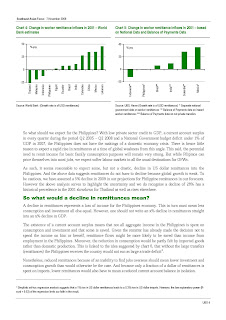


Investor concerns about remittance flows into the Philippines has jumped, both with the dramatic deterioration in dollar liquidity in Asian markets and de-leveraging flows. These concerns were all the more heightened by the slowdown in remittance growth from 25% on the year in July to just 10% yoy in August.
We take a look at Philippines remittance flows in an international context. Given our projection of the worst global growth environment since the early 1980s, it is quite easy to see how Philippines remittance flows could see some declines in 2009. However, because the Philippines will also benefit from lower commodity prices, we expect the Philippines’ current account balance to rise in 2009 relative to 2008 even with lower remittances. This will be a plus for the peso and help sustain the currency verses the US dollar once de-leveraging flows abate.
Near term, however, we remain cautious, although the fierceness of the de-leveraging trend does appear to have lessened in recent days.
Near term, however, we remain cautious, although the fierceness of the de-leveraging trend does appear to have lessened in recent days.


Outsourcing Solves Cost issues Amidst the US Financial Crisis
Third-party specialists hired to fulfill non-core business initiatives—ExcelAsia
The advent of the global financial crisis has resulted in the emergence of outsourcing as a strategic solution for multinational companies. The Business Process Association of the Philippines reported that this year’s goal of 40% revenue growth for the Philippine business process outsourcing industry remains on track despite early threats posed by the US financial crisis.
ExcelAsia President Rita Trillo-Ugarte shares that outsourcing allows global companies to focus more on their core business, and that there are plenty of opportunities for the country.
“Even if global companies downsized their workforce as a cost-cutting solution, there will still be plenty of work left to be done,” said Trillo-Ugarte. “This is where the Philippines becomes a strategic location for new outsourcing opportunities. Companies who used to outsource call centers only will now consider outsourcing their back offices too.”
ExcelAsia is one of the leading human resource (HR) solutions company in the Philippines, with 35 BPO clients served though recruitment, training, executive search, and HR and business development consultancy.
The HR solutions company even has increased business partnerships despite the global crisis. ExcelAsia has new BPO clients requesting for 500 monthly endorsements, increasing the company’s current roster of 35 clients and endorsements for all its sites.
“Outsourcing training facilities to a third-party specialist is becoming more valuable among our BPO clients,” Trillo-Ugarte said. “Companies that conduct their own recruitment and training need big facilities and additional HR professionals. These initiatives are not part of their core business. Outsourcing these processes to HR specialists like ExcelAsia, which specializes in recruitment and training, results in cost and effort savings that can be applied to their core business.”
According to Trillo-Ugarte, their BPO clients can halve training costs because ExcelAsia has the expertise needed to do the job. The cost savings frees up resources for their BPO clients to concentrate on expanding their respective businesses.
Trillo-Ugarte emphasizes that in addition to providing savings, ExcelAsia also works to maintain the quality of the agents’ skills once they are on board through specialized training programs specifically developed for clients.
The advent of the global financial crisis has resulted in the emergence of outsourcing as a strategic solution for multinational companies. The Business Process Association of the Philippines reported that this year’s goal of 40% revenue growth for the Philippine business process outsourcing industry remains on track despite early threats posed by the US financial crisis.
ExcelAsia President Rita Trillo-Ugarte shares that outsourcing allows global companies to focus more on their core business, and that there are plenty of opportunities for the country.
“Even if global companies downsized their workforce as a cost-cutting solution, there will still be plenty of work left to be done,” said Trillo-Ugarte. “This is where the Philippines becomes a strategic location for new outsourcing opportunities. Companies who used to outsource call centers only will now consider outsourcing their back offices too.”
ExcelAsia is one of the leading human resource (HR) solutions company in the Philippines, with 35 BPO clients served though recruitment, training, executive search, and HR and business development consultancy.
The HR solutions company even has increased business partnerships despite the global crisis. ExcelAsia has new BPO clients requesting for 500 monthly endorsements, increasing the company’s current roster of 35 clients and endorsements for all its sites.
“Outsourcing training facilities to a third-party specialist is becoming more valuable among our BPO clients,” Trillo-Ugarte said. “Companies that conduct their own recruitment and training need big facilities and additional HR professionals. These initiatives are not part of their core business. Outsourcing these processes to HR specialists like ExcelAsia, which specializes in recruitment and training, results in cost and effort savings that can be applied to their core business.”
According to Trillo-Ugarte, their BPO clients can halve training costs because ExcelAsia has the expertise needed to do the job. The cost savings frees up resources for their BPO clients to concentrate on expanding their respective businesses.
Trillo-Ugarte emphasizes that in addition to providing savings, ExcelAsia also works to maintain the quality of the agents’ skills once they are on board through specialized training programs specifically developed for clients.
Petroleum and Mineral Products Keep September Exports Afloat
Exports of petroleum as well as mineral products contributed significantly to the increase in total export receipts in September this year. This is despite the drop in the exports of electronic products that triggered the slowdown of the total merchandise exports to 1.2 percent in the said month from the revised 6.6 percent growth in August and the revised 5.1 percent increase posted in the same period last year.
Merchandise export receipts reached US$4.4 billion in September bringing them to US$38.9 billion for the first three quarters of 2008 or a 4.0-percent growth from the same period last year.
In his memorandum to President Gloria Macapagal Arroyo, Socioeconomic Planning Secretary and NEDA Director General Ralph G. Recto said that both value and volume of petroleum exports posted positive growth rates at 102.6 percent and 16.0 percent, respectively.
“The bulk of outward shipments of petroleum products were brought to Singapore, Taipei ROC and Indonesia,” Recto said.
Likewise, Recto said that despite the 30.5 percent contraction in volume, exports of mineral products continued to post double-digit growth at 17.9 percent. This, he said, was attributed to the 40.4 percent surge in the value of exports of copper metal which comprised two-thirds of the total outward mineral shipments in September. Chromium ore and other minerals also contributed to the boost in mineral exports.
“About 75.5 percent of the total mineral exports in September went to South Korea, Japan and Thailand,” the socioeconomic planning secretary added.
Aside from electronic products exports, garments also suffered a significant reduction in volume of shipments.
“This would be due to decline in demand at the onset of the September global financial turmoil and the continuing slowdown in major economies,” Recto said.
Meanwhile, the United States regained its post as top export destination in September registering an 18.2-percent share from 14.9 percent in the previous month, with electronic data processing equipment, garments and semiconductors as the main exports.
Japan, which was the top destination in August, slid to second place with a 14.4-percent share. Other top export markets were China PRC (11.1%), Hong Kong SAR (9.9%), and the Netherlands (7.7%). The combined exports to China PRC, Hong Kong SAR and Taipei ROC accounted for 25.2 percent of the total merchandise exports in September.
-end
Merchandise export receipts reached US$4.4 billion in September bringing them to US$38.9 billion for the first three quarters of 2008 or a 4.0-percent growth from the same period last year.
In his memorandum to President Gloria Macapagal Arroyo, Socioeconomic Planning Secretary and NEDA Director General Ralph G. Recto said that both value and volume of petroleum exports posted positive growth rates at 102.6 percent and 16.0 percent, respectively.
“The bulk of outward shipments of petroleum products were brought to Singapore, Taipei ROC and Indonesia,” Recto said.
Likewise, Recto said that despite the 30.5 percent contraction in volume, exports of mineral products continued to post double-digit growth at 17.9 percent. This, he said, was attributed to the 40.4 percent surge in the value of exports of copper metal which comprised two-thirds of the total outward mineral shipments in September. Chromium ore and other minerals also contributed to the boost in mineral exports.
“About 75.5 percent of the total mineral exports in September went to South Korea, Japan and Thailand,” the socioeconomic planning secretary added.
Aside from electronic products exports, garments also suffered a significant reduction in volume of shipments.
“This would be due to decline in demand at the onset of the September global financial turmoil and the continuing slowdown in major economies,” Recto said.
Meanwhile, the United States regained its post as top export destination in September registering an 18.2-percent share from 14.9 percent in the previous month, with electronic data processing equipment, garments and semiconductors as the main exports.
Japan, which was the top destination in August, slid to second place with a 14.4-percent share. Other top export markets were China PRC (11.1%), Hong Kong SAR (9.9%), and the Netherlands (7.7%). The combined exports to China PRC, Hong Kong SAR and Taipei ROC accounted for 25.2 percent of the total merchandise exports in September.
-end
Some Unsolicited Ideas on Coping with Financial Stresses
Dear Sec Gary, Dof Friends:
I hope you are keeping well despite these trying times.
The spike in RoP spreads and your most helpful briefing on BSP is doing reminded me of a piece I wrote four years ago. "Dollar RoP's: blessing or curse?" (below). I said there that the banks then were holding $ 9 billion in RoP's ( per the info we got, I think from BSP), of $ 13 billion in FCDU deposits . Gigi mentined only $ 5.5 as total bank holdings of RoP's, including trust and CLN's. (Around a fifth of FCDU deposits of over $ 25 billion, around 5 % of total bank assets.) Are these numbers also what you have? So we are actually much better placed than four years ago-- I guess the BSP's requiring full risk charge to capital for RoP's must have made banks reduce exposure in it? Or maybe the warrants you offered are netted out? ( Maybe good idea to do more?)
In that 2004 article, I was pushing for strengthening fiscal accounts (fiscal deficit then 5% of GDP vs. 1% now) , as needed to reduce risks arising from RoP concentration. Though the origins now of pressure on RoP value are wholly external, it is still helpful, I think, that government strengthens fiscal position-- so it does not add even more risks to an already nervous market. And, if needed, so that it will have the fiscal space to support the financial system. Thankfully, we are better placed now than in 2004-- but still continues to be fragile. ( Our public debt to GDP ratio down from 95% in 2004 to 66 % currently , but even at the lower level, still higher than our similarly rated peers-- even, Argentina's a year ago, though maybe not anymore..)
Some of the things that can be done to strengthen fiscal position--indexing sin taxes, rationalizing fiscal incentives, better collection of oil taxes, that will help offset reduction in collection due to slowdown, decline in corp income tax etc. -- and our leaders need to talk less about fiscal stimulus like raising tax exemptions, NFA spending and\ fertilizers- and do instead more efficient support like conditional cash transfers. We may even be able to get World Bank and ADB support for these reforms and thus help our BSP with augmentation in country's reserves at much lower cost than RoP market. ( Which should also help assuage markets, and keep us away from IMF program.)
Sharing these with you as key tested veterans of two previous financial crisis with much credibility whom political leaders in the Executive and Legislative branch-- who are often driven by reacting or talking without CSW.
Good wishes,
Romy (bernardo)
Dollar RoPs: blessing or curse?
Tuesday, October 5, 2004
BusinessWorld
By ROMEO L. BERNARDO
One aspect of government's debt problem that seems to have missed scrutiny is the large share of dollar-denominated securities issued in the international capital markets.
Popularly known as RoPs, these securities comprise 42% of government's outstanding foreign debt in 2003 compared with just 11% in 1999 (from almost nil in the early '90s). What is the significance of this?
As has often been discussed, this large exposure to the capital markets means that unlike in the past decade, government today is much more exposed to the international market's mood swings. This makes it vulnerable to "event risk," or the risk of some unexpected "news," economic or political, causing markets to close down abruptly, with government either unable to
refinance its maturing obligations or to refinance at reasonable terms.
With the country's large refinancing requirements (roughly $3 billion in 2005 for both the national government and NPC, not counting refinancing needs of private dollar bond issuers), a sudden confidence run can be costly in terms of the additional spread demanded by the market or worse, can precipitate a payments crisis.
Much less talked about is the link between fiscal solvency and financial sector solvency resulting from these RoPs. Given the attractiveness of RoPs yield-wise (estimated after tax peso return of 18% for the 10-year bond), and regulation-wise (no capital charge under currently-adopted risk-based capital standards), local banks have become major buyers of RoPs, crowding out private investments hard-pressed to compete with such superior risk-reward features. It is estimated that about US$9 billion out of US$13 billion assets of local FCDUs are invested in government's foreign currency-denominated securities. What's more, banks are not simply booking ROPs but have developed derivative instruments with ROPs as underlying assets that multiply leverage and vulnerability. These activities provide a channel through which a fiscal crisis can feed into a financial crisis.
It has been observed that a significant portion of RoPs finds its way into local hands through the banking system.
By itself, this offers some comfort as local investors can be expected to have greater appetite for its own government's risk, insulating government from any knee-jerk market reaction.
Also, under existing prudential standards where RoPs are zero risk-weighted even though they provide yields equivalent to "junk bonds", buying RoPs is a "no brainer" for banks and thus, banks and their clients constitute a captive market for these government issues, helping to bring down government's borrowing cost.
From a financial sector stability viewpoint, however, the magnitude of banks' exposure to government risk gives one pause.
On the one hand, most depositors in all likelihood do not even realize that their banks are heavily invested in RoPs, or even if they do, have limited options to move deposit accounts out of the country, especially with stringent international protocols in place pertaining to anti-money
laundering ("know your customers").
On the other hand, at the time of its debt default in 2001, Argentina's banks were similarly exposed to government risk through their holdings of government local and foreign currency bonds and loans.
Although total exposure was not extreme -- reportedly 21% of total assets in 2000, this was a source of vulnerability for the banking system, especially when confidence started to wane and depositors ran for the exit.
As analysts observed, moves in 2000 to de-link the financial system from the fiscal problem, e.g., marking government bonds to market, requiring positive weighting for government loans, came a little too late to shield the system from the fiscal blowup.
Of course, the Philippines is not in the same boat as Argentina.
Argentina's crisis was a confluence of several factors, consisting not only of weak public finances and a banking system vulnerable to government default, but perhaps most importantly, an overvalued currency due both to the appreciation of the dollar (to which the Argentine peso was pegged under a currency board arrangement) against the euro (Argentina's major trading partners) and the devaluation of Brazil's currency, which reduced
the competitiveness of Argentina's exports.
Thus, while Argentina's fiscal deficits like ours ran unabated, it also incurred deficits in its current account and experienced declines in its international reserves, at the same time that its domestic economy was contracting. Even with a large support package from the IMF in late 2000 to help restore confidence, Argentina failed to avert the crisis and in the end, had to abandon its currency peg.
In contrast, thanks to remittances from OFWs, the Philippines continues to enjoy stable, even if low-quality, GDP growth. This suggests that to some extent, government may continue to incur new debt without raising the debt ratio (assuming that the current debt ratio is optimal).
At the same time, our current account is in surplus, thus providing some assurance that dollars are available in the system even if government, for some reason, is unable to refinance its debt (at over US$3 billion, the current account surplus is just enough to meet government's refinancing requirements). The Philippines also does not have the problem of an overvalued currency masking the real magnitude of the country's debt, which should make it politically easier to pass policy reforms to correct weaknesses in the fiscal sector.
Be that as it may, there are vulnerabilities in the economy that should preclude complacency, with the fiscal problem at the top of the list. Also, it is in the nature of a highly leveraged financial system that a confidence run, triggered by one or several concurrent or sequential events (e.g., default of a large borrower, oil price shock, interest rate spike), may cause serious systemic breakdown. The fact that a crisis may be event-triggered makes it hard to predict. Is it two years as the UP economists forecasted? One year as predicted by Congressman Joey Salceda?
Or, six more years provided we can muddle through with some modicum of revenue measures, e.g., Bayanihan Fund, pseudo indexation of sin taxes, a brain-dead gross income tax, and an incredible "tax amnesty"? Who knows?
Thinking about our leveraged banking system and the vulnerabilities engendered by public debt build up, the picture in my mind is of a man standing tiptoed on one leg. I can't help but imagine how a little gust of wind or even a fly on his nose can cause him to topple over. This makes it all the more urgent for action on the fiscal front to raise market confidence, both in government and the banking system.
But there is an even more fundamental reason why urgent action needs to be taken. We may very well defuse the debt bomb by good fortune or brinkmanship. But is that all we are trying to achieve? Isn't it the role of government to create an economic and financial environment that is conducive to sustainable, higher quality growth, that encourages long-term investments and that keeps Filipinos productively employed at home? And isn't that compatible only with a robust fiscal and debt position over the long term?
I hope you are keeping well despite these trying times.
The spike in RoP spreads and your most helpful briefing on BSP is doing reminded me of a piece I wrote four years ago. "Dollar RoP's: blessing or curse?" (below). I said there that the banks then were holding $ 9 billion in RoP's ( per the info we got, I think from BSP), of $ 13 billion in FCDU deposits . Gigi mentined only $ 5.5 as total bank holdings of RoP's, including trust and CLN's. (Around a fifth of FCDU deposits of over $ 25 billion, around 5 % of total bank assets.) Are these numbers also what you have? So we are actually much better placed than four years ago-- I guess the BSP's requiring full risk charge to capital for RoP's must have made banks reduce exposure in it? Or maybe the warrants you offered are netted out? ( Maybe good idea to do more?)
In that 2004 article, I was pushing for strengthening fiscal accounts (fiscal deficit then 5% of GDP vs. 1% now) , as needed to reduce risks arising from RoP concentration. Though the origins now of pressure on RoP value are wholly external, it is still helpful, I think, that government strengthens fiscal position-- so it does not add even more risks to an already nervous market. And, if needed, so that it will have the fiscal space to support the financial system. Thankfully, we are better placed now than in 2004-- but still continues to be fragile. ( Our public debt to GDP ratio down from 95% in 2004 to 66 % currently , but even at the lower level, still higher than our similarly rated peers-- even, Argentina's a year ago, though maybe not anymore..)
Some of the things that can be done to strengthen fiscal position--indexing sin taxes, rationalizing fiscal incentives, better collection of oil taxes, that will help offset reduction in collection due to slowdown, decline in corp income tax etc. -- and our leaders need to talk less about fiscal stimulus like raising tax exemptions, NFA spending and\ fertilizers- and do instead more efficient support like conditional cash transfers. We may even be able to get World Bank and ADB support for these reforms and thus help our BSP with augmentation in country's reserves at much lower cost than RoP market. ( Which should also help assuage markets, and keep us away from IMF program.)
Sharing these with you as key tested veterans of two previous financial crisis with much credibility whom political leaders in the Executive and Legislative branch-- who are often driven by reacting or talking without CSW.
Good wishes,
Romy (bernardo)
Dollar RoPs: blessing or curse?
Tuesday, October 5, 2004
BusinessWorld
By ROMEO L. BERNARDO
One aspect of government's debt problem that seems to have missed scrutiny is the large share of dollar-denominated securities issued in the international capital markets.
Popularly known as RoPs, these securities comprise 42% of government's outstanding foreign debt in 2003 compared with just 11% in 1999 (from almost nil in the early '90s). What is the significance of this?
As has often been discussed, this large exposure to the capital markets means that unlike in the past decade, government today is much more exposed to the international market's mood swings. This makes it vulnerable to "event risk," or the risk of some unexpected "news," economic or political, causing markets to close down abruptly, with government either unable to
refinance its maturing obligations or to refinance at reasonable terms.
With the country's large refinancing requirements (roughly $3 billion in 2005 for both the national government and NPC, not counting refinancing needs of private dollar bond issuers), a sudden confidence run can be costly in terms of the additional spread demanded by the market or worse, can precipitate a payments crisis.
Much less talked about is the link between fiscal solvency and financial sector solvency resulting from these RoPs. Given the attractiveness of RoPs yield-wise (estimated after tax peso return of 18% for the 10-year bond), and regulation-wise (no capital charge under currently-adopted risk-based capital standards), local banks have become major buyers of RoPs, crowding out private investments hard-pressed to compete with such superior risk-reward features. It is estimated that about US$9 billion out of US$13 billion assets of local FCDUs are invested in government's foreign currency-denominated securities. What's more, banks are not simply booking ROPs but have developed derivative instruments with ROPs as underlying assets that multiply leverage and vulnerability. These activities provide a channel through which a fiscal crisis can feed into a financial crisis.
It has been observed that a significant portion of RoPs finds its way into local hands through the banking system.
By itself, this offers some comfort as local investors can be expected to have greater appetite for its own government's risk, insulating government from any knee-jerk market reaction.
Also, under existing prudential standards where RoPs are zero risk-weighted even though they provide yields equivalent to "junk bonds", buying RoPs is a "no brainer" for banks and thus, banks and their clients constitute a captive market for these government issues, helping to bring down government's borrowing cost.
From a financial sector stability viewpoint, however, the magnitude of banks' exposure to government risk gives one pause.
On the one hand, most depositors in all likelihood do not even realize that their banks are heavily invested in RoPs, or even if they do, have limited options to move deposit accounts out of the country, especially with stringent international protocols in place pertaining to anti-money
laundering ("know your customers").
On the other hand, at the time of its debt default in 2001, Argentina's banks were similarly exposed to government risk through their holdings of government local and foreign currency bonds and loans.
Although total exposure was not extreme -- reportedly 21% of total assets in 2000, this was a source of vulnerability for the banking system, especially when confidence started to wane and depositors ran for the exit.
As analysts observed, moves in 2000 to de-link the financial system from the fiscal problem, e.g., marking government bonds to market, requiring positive weighting for government loans, came a little too late to shield the system from the fiscal blowup.
Of course, the Philippines is not in the same boat as Argentina.
Argentina's crisis was a confluence of several factors, consisting not only of weak public finances and a banking system vulnerable to government default, but perhaps most importantly, an overvalued currency due both to the appreciation of the dollar (to which the Argentine peso was pegged under a currency board arrangement) against the euro (Argentina's major trading partners) and the devaluation of Brazil's currency, which reduced
the competitiveness of Argentina's exports.
Thus, while Argentina's fiscal deficits like ours ran unabated, it also incurred deficits in its current account and experienced declines in its international reserves, at the same time that its domestic economy was contracting. Even with a large support package from the IMF in late 2000 to help restore confidence, Argentina failed to avert the crisis and in the end, had to abandon its currency peg.
In contrast, thanks to remittances from OFWs, the Philippines continues to enjoy stable, even if low-quality, GDP growth. This suggests that to some extent, government may continue to incur new debt without raising the debt ratio (assuming that the current debt ratio is optimal).
At the same time, our current account is in surplus, thus providing some assurance that dollars are available in the system even if government, for some reason, is unable to refinance its debt (at over US$3 billion, the current account surplus is just enough to meet government's refinancing requirements). The Philippines also does not have the problem of an overvalued currency masking the real magnitude of the country's debt, which should make it politically easier to pass policy reforms to correct weaknesses in the fiscal sector.
Be that as it may, there are vulnerabilities in the economy that should preclude complacency, with the fiscal problem at the top of the list. Also, it is in the nature of a highly leveraged financial system that a confidence run, triggered by one or several concurrent or sequential events (e.g., default of a large borrower, oil price shock, interest rate spike), may cause serious systemic breakdown. The fact that a crisis may be event-triggered makes it hard to predict. Is it two years as the UP economists forecasted? One year as predicted by Congressman Joey Salceda?
Or, six more years provided we can muddle through with some modicum of revenue measures, e.g., Bayanihan Fund, pseudo indexation of sin taxes, a brain-dead gross income tax, and an incredible "tax amnesty"? Who knows?
Thinking about our leveraged banking system and the vulnerabilities engendered by public debt build up, the picture in my mind is of a man standing tiptoed on one leg. I can't help but imagine how a little gust of wind or even a fly on his nose can cause him to topple over. This makes it all the more urgent for action on the fiscal front to raise market confidence, both in government and the banking system.
But there is an even more fundamental reason why urgent action needs to be taken. We may very well defuse the debt bomb by good fortune or brinkmanship. But is that all we are trying to achieve? Isn't it the role of government to create an economic and financial environment that is conducive to sustainable, higher quality growth, that encourages long-term investments and that keeps Filipinos productively employed at home? And isn't that compatible only with a robust fiscal and debt position over the long term?
Will the BSP cut policy rates?
Romeo Bernardo & Marie-Christine Tang
Nine out of 10 bank treasurers polled by a local newspaper forecast no change in policy rates when the Monetary Board meets this Thursday. The rationale for the majority view seems to be that with the two-percentage point reduction in banks’ reserve requirements effective last November 14, monetary authorities are likely to keep watch of developments first before taking further action.
While that may well be the case, the policy debate within the Bangko Sentral ng Pilipinas (BSP) can be expected to be less straightforward. The talk in banking circles is that there are two points of view within the BSP/ Monetary Board. On one side is the view that policy rates need to stay put as inflation remains a threat (core inflation is after all still rising), especially with the continued weakening of the peso. On the other side is the fear that failure to ease monetary conditions, via a 25bp cut in the policy rate, may prove harmful to banks in the first instance, especially those with liquidity constraints. Down the road, given a looming global recession, the economy may be affected as well.
The latter view has been a major worry since the Lehman collapse. This may be gleaned from the various measures implemented by the BSP over the past month (Table 1) to ensure smooth liquidity flow in the financial system. Although market risk has receded somewhat in recent weeks following the recovery in asset prices, credit risk may emerge as a concern in the future as corporates (including real estate firms exposed to risks of project completion and insufficient demand) are seen to face tougher times from slower growth while banks are expected to tighten credit standards.

Already, analysts are looking at big corporates with large foreign exchange-denominated liabilities that are contending with roll-over risk.
That said, we tend to side with the view that now may not be the best time to cut interest rates.
Quite apart from firm liquidity growth (M3 grew 13.5% in September vs. 9.8% in August), we think that the BSP will be wary of actions that may cause the peso to depreciate more. From a high of P40.36/$ in February this year, the peso has depreciated to nearly P50/$ in recent trading. Already, BSP dollar sales to temper the peso’s fall (due to capital outflows driven primarily by the global liquidity crunch) has reduced its swap position from over $13 billion at the start of the year to just $2.7 billion as of end-September. Moreover, its official reserves have dropped by $1 billion to $35.7 billion in October such that a smaller BOP surplus (vs. the $2 billion projected by the BSP) is expected for the year.
World Bank Calls on Donors to Boost Aid for Developing Countries
Washington DC-- As development experts prepare for the
International Conference on Financing for Development in Doha, Qatar, the World
Bank is calling on donors to further boost aid as investment in developing
countries heads for a “perfect storm.”
“Developed country policymakers must avoid putting in place policies and
structures that undermine the interests of developing countries,” said World
Bank President, Robert B. Zoellick. “Courageous steps have been taken by many
developing country governments in recent years to introduce and maintain sound
macroeconomic and fiscal policies. They now find themselves at the mercy of a
crisis not of their making. A retreat to protectionism or economic nationalism
by developed countries will hurt them even further.”
In a paper prepared for the Doha Follow-up Conference on Financing for
Development to Review the Implementation of the Monterrey Consensus, the World
Bank said it is imperative that donors meet their Gleneagles commitments to debt
relief and scaled-up aid. At present, G7 countries are falling $30 billion short
of these goals. According to the paper, The Implications of Global Crises on
Developing Countries, the Millennium Development Goals, and the Monterrey
Consensus, developing countries are facing a "perfect storm," with a convergence
of slowing world growth, a withdrawal of equity and lending from the private
sector, and higher interest rates.
Investment, the main driver of developing country growth over the past five
years, will be hard hit by the financial crisis, and remittances from developing
country migrants—a powerful poverty reduction mechanism—will likely decline in
line with the global slowdown. All this comes in the wake of the severe food and
fuel price crises, which placed a heavy fiscal, economic and social burden on
many developing countries.
Reflecting deteriorating global conditions, the World Bank has revised its 2009
growth forecast downward. Developing country growth in 2009 is now forecast at
4,5 percent, nearly 2 percentage points lower than previously estimated; growth
in high-income countries, many of which are already in the midst of recession,
is now expected to be marginally negative in 2009. The volume of global trade is
projected to contract in 2009, the first decline since 1982.
"This is not just about finance, as crucial as that is,” Zoellick said. "In a
world where developing countries represent new drivers of global growth, we must
learn to listen to their experiences, and we must take better account of their
needs. "Financing for development is no longer about the old paradigm of aid
dependency or charity, it is about an investment in a stable, prosperous and
inclusive future - that means having more and different voices at the table,
and accepting that the North must learn to listen to the South. "
Heading the World Bank delegation to Doha, Justin Yifu Lin, the World Bank's
Chief Economist and the first such appointee from a developing country, said
"This unfolding crisis highlights the extent of our global connectedness and has
left us in a position whereby, in the next year, developing countries could
account for all of the world's GDP growth. In this transformed world,
empowering developing and emerging countries is imperative."
"Financing for development should focus more on adapting to countries'
conditions and aspirations,” continued Lin. “It should be geared toward working
with governments and stakeholders in those countries to support practical
economic development programs. Helping nations pursue economic development and
long term prosperity should be the goal of development finance. We must not
lose sight of this principle amidst the current crisis."
To meet growing needs, President Zoellick has announced that the Bank Group will
front load the $42 billion it has available to support low-income (IDA)
countries over the next three years, and rely on its strong capital basis to
lend up to $100 billion to developing countries over the same period. IFC, the
private sector arm of the Bank Group, is also increasing support, doubling the
Global Trade Finance Program to $3 billion, launching a global equity fund with
support from the Government of Japan to recapitalize distressed banks, and
establishing a new facility to provide roll-over financing to existing, viable,
privately funded infrastructure projects facing financial distress.
International Conference on Financing for Development in Doha, Qatar, the World
Bank is calling on donors to further boost aid as investment in developing
countries heads for a “perfect storm.”
“Developed country policymakers must avoid putting in place policies and
structures that undermine the interests of developing countries,” said World
Bank President, Robert B. Zoellick. “Courageous steps have been taken by many
developing country governments in recent years to introduce and maintain sound
macroeconomic and fiscal policies. They now find themselves at the mercy of a
crisis not of their making. A retreat to protectionism or economic nationalism
by developed countries will hurt them even further.”
In a paper prepared for the Doha Follow-up Conference on Financing for
Development to Review the Implementation of the Monterrey Consensus, the World
Bank said it is imperative that donors meet their Gleneagles commitments to debt
relief and scaled-up aid. At present, G7 countries are falling $30 billion short
of these goals. According to the paper, The Implications of Global Crises on
Developing Countries, the Millennium Development Goals, and the Monterrey
Consensus, developing countries are facing a "perfect storm," with a convergence
of slowing world growth, a withdrawal of equity and lending from the private
sector, and higher interest rates.
Investment, the main driver of developing country growth over the past five
years, will be hard hit by the financial crisis, and remittances from developing
country migrants—a powerful poverty reduction mechanism—will likely decline in
line with the global slowdown. All this comes in the wake of the severe food and
fuel price crises, which placed a heavy fiscal, economic and social burden on
many developing countries.
Reflecting deteriorating global conditions, the World Bank has revised its 2009
growth forecast downward. Developing country growth in 2009 is now forecast at
4,5 percent, nearly 2 percentage points lower than previously estimated; growth
in high-income countries, many of which are already in the midst of recession,
is now expected to be marginally negative in 2009. The volume of global trade is
projected to contract in 2009, the first decline since 1982.
"This is not just about finance, as crucial as that is,” Zoellick said. "In a
world where developing countries represent new drivers of global growth, we must
learn to listen to their experiences, and we must take better account of their
needs. "Financing for development is no longer about the old paradigm of aid
dependency or charity, it is about an investment in a stable, prosperous and
inclusive future - that means having more and different voices at the table,
and accepting that the North must learn to listen to the South. "
Heading the World Bank delegation to Doha, Justin Yifu Lin, the World Bank's
Chief Economist and the first such appointee from a developing country, said
"This unfolding crisis highlights the extent of our global connectedness and has
left us in a position whereby, in the next year, developing countries could
account for all of the world's GDP growth. In this transformed world,
empowering developing and emerging countries is imperative."
"Financing for development should focus more on adapting to countries'
conditions and aspirations,” continued Lin. “It should be geared toward working
with governments and stakeholders in those countries to support practical
economic development programs. Helping nations pursue economic development and
long term prosperity should be the goal of development finance. We must not
lose sight of this principle amidst the current crisis."
To meet growing needs, President Zoellick has announced that the Bank Group will
front load the $42 billion it has available to support low-income (IDA)
countries over the next three years, and rely on its strong capital basis to
lend up to $100 billion to developing countries over the same period. IFC, the
private sector arm of the Bank Group, is also increasing support, doubling the
Global Trade Finance Program to $3 billion, launching a global equity fund with
support from the Government of Japan to recapitalize distressed banks, and
establishing a new facility to provide roll-over financing to existing, viable,
privately funded infrastructure projects facing financial distress.
Subscribe to:
Posts (Atom)